
Today, schools are comparing pricing more carefully than ever before.
And honestly, they should.
Because many schools in India are now paying huge yearly amounts for ERP software that still feels incomplete.
Some platforms charge extra for mobile apps.
Some charge separately for online exams.
Others keep important modules locked behind “premium plans.”
This is why schools are now searching terms like:
- school management software price
- school ERP price in India
- affordable school ERP software
- school ERP pricing comparison
more frequently than ever.
Especially during June and July, when schools prepare for the new academic session, ERP searches increase rapidly across India.
But one important question still remains:
How much should a school actually pay for ERP software?
The answer depends on features, scalability, and transparency.
And this is exactly where many schools get confused.
The Reality of School ERP Pricing in India
If you search for school ERP software today, you will notice something interesting.
Most ERP companies divide their pricing into three categories:
1. Basic School Software
These are low-feature systems mainly designed for attendance and fee collection.
Pricing often starts around:
- ₹20,000 to ₹25,000 per year
But the problem is that these systems usually provide only limited functionality.
Schools still end up managing many tasks manually.
2. Mid-Level ERP Software
These platforms include:
- Attendance
- Fees
- Exams
- Parent communication
- Mobile apps
Pricing usually increases to:
- ₹15–₹20 per student/month
For a school with 1000 students, this becomes:
- ₹1.8 lakh to ₹2.4 lakh yearly
And surprisingly, many providers still charge extra for additional features.
3. Enterprise School ERP Systems
These are large ERP platforms focused on enterprise-level institutions.
Pricing can easily reach:
- ₹30–₹35 per student/month
which becomes extremely expensive for growing schools.
For example:
A school with 2500 students may end up paying several lakhs yearly for ERP software alone.
And even then, some modules are billed separately.
This is one of the biggest reasons schools are now searching for affordable school management software in India.
Why Many Schools Feel ERP Software Is Overpriced
The biggest frustration schools face is not just pricing.
It is hidden pricing.
Many ERP providers advertise low starting plans, but later schools discover additional charges for:
- Mobile apps
- WhatsApp integration
- SMS systems
- Online exams
- Report cards
- Transport management
- Biometric integrations
- Support services
Over time, the total ERP cost becomes much higher than expected.
This creates disappointment for school administrators who initially believed they were choosing a cost-effective solution.
That is why schools today are no longer searching only for “best ERP software.”
They are searching for:
What Schools Actually Need From ERP Software
Many schools do not need overly complicated enterprise systems.
What they really need is:
- Easy management
- All important modules
- Reliable support
- Mobile access
- Affordable pricing
- Long-term scalability
Schools want software that solves real administrative problems without creating new technical complexity.
This is especially important for small and medium schools.
Because these institutions often manage everything with limited staff.
The Biggest Mistake Schools Make While Choosing ERP
One common mistake schools make is comparing ERP software only by yearly pricing.
This creates confusion.
For example:
A software charging ₹25,000 yearly may initially look affordable.
But later schools discover:
- limited modules
- paid upgrades
- missing communication tools
- no proper mobile app
- restricted reports
On the other hand, some expensive ERP systems provide hundreds of features that schools may never actually use.
The smartest approach is not choosing the cheapest ERP.
It is choosing the ERP with the best feature-to-price ratio.
And this is where modern cloud-based ERP systems are changing the market.
School Management Software Price Depends on Features
ERP pricing usually depends on four major things:
1. Number of Students
Most ERP companies charge per student.
As student count increases, pricing increases rapidly.
2. Included Modules
Basic software may only include:
- Attendance
- Fees
- Basic reports
while advanced ERP systems include:
- Online exams
- Parent apps
- Transport management
- HR systems
- WhatsApp alerts
- Library management
- Live classes
- Inventory systems
3. Mobile Applications
Some providers charge separately for:
- Parent app
- Staff app
- Student app
This increases yearly costs significantly.
4. Cloud Infrastructure & Support
Cloud-based systems with reliable support and regular backups usually cost more to maintain.
But they also provide better stability and security.
Why Schools Are Moving Towards Cloud-Based ERP Systems
Traditional offline school software is slowly becoming outdated.
Modern schools now prefer cloud-based school management software because it offers:
- Remote access
- Better backups
- Mobile compatibility
- Faster updates
- Real-time synchronization
Cloud ERP systems also reduce dependency on office computers and local data storage.
This is why cloud school ERP software is growing rapidly across India.
What Makes EduERP.cloud Different?
This is where EduERP.cloud positions itself differently from many traditional ERP providers.
Instead of charging extremely high per-student pricing, the platform focuses on:
- affordability
- feature completeness
- usability
- scalability
while still providing a modern ERP experience.
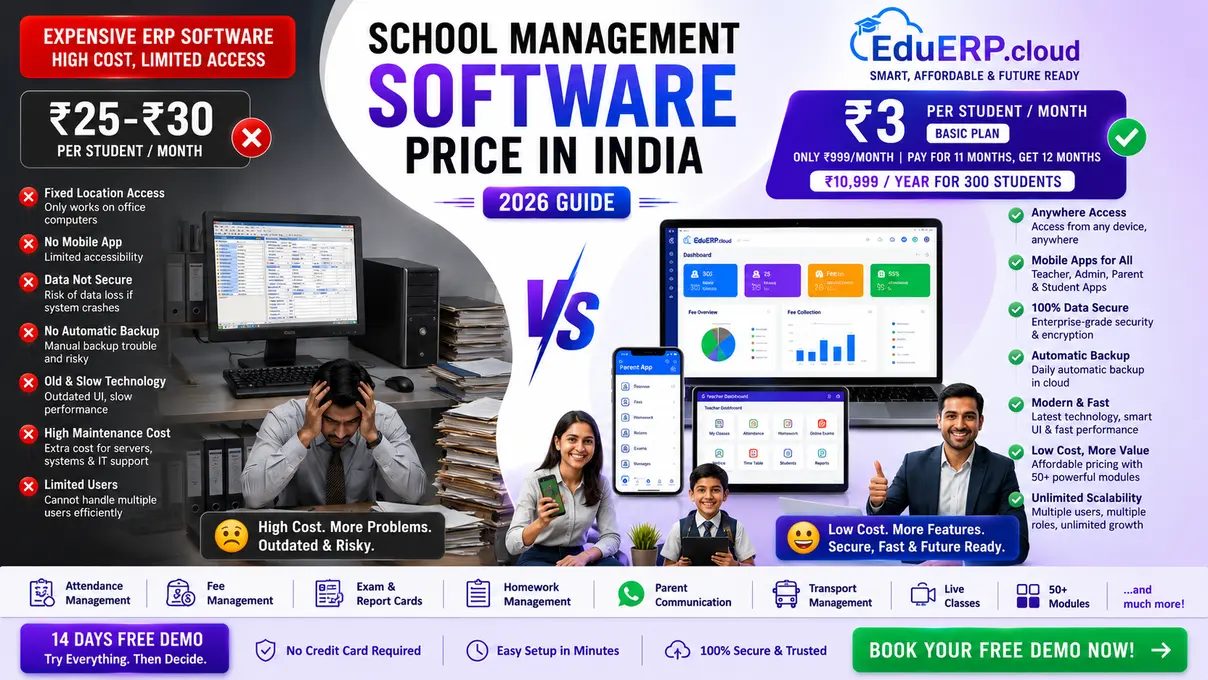
Many ERP systems charging ₹30–₹35 per student/month still limit important modules.
Even budget ERP providers charging ₹15–₹20 per student/month often provide fewer features than expected.
EduERP.cloud approaches the problem differently.
The idea is simple:
EduERP.cloud Pricing Structure
For schools comparing school management software price in India, this becomes extremely important.
EduERP.cloud pricing currently starts around:
₹10,999/year for 300 students
which comes close to approximately:
₹3 per student/month
And unlike many ERP providers, the platform includes:
- Attendance system
- Fee management
- Exams & report cards
- Parent communication
- Mobile apps
- Online classes
- Homework management
- Transport management
- HR modules
- WhatsApp notifications
- Cloud backups
- Analytics dashboards
inside the ecosystem itself.
For larger schools:
Full-featured plans go up to around ₹59,000/year for 2500 students
which creates one of the strongest feature-to-pricing combinations available in the Indian school ERP market.
50+ Modules Included Without Hidden Charges
One of the strongest advantages of EduERP.cloud is transparency.
Many ERP systems increase pricing as schools unlock more functionality.
EduERP.cloud focuses on complete ERP access instead of modular upselling.
Schools get access to modules like:
- Admissions & Enrollment
- Attendance Management
- Online Exams
- Homework & Assignments
- Timetable Management
- Report Cards
- Fee Collection
- Payroll System
- WhatsApp Notifications
- SMS & Email Alerts
- Parent Mobile App
- Staff Mobile App
- Library Management
- Inventory Management
- Transport Management
- Hostel Management
- Biometric Integration
- Tally Integration
- Live Online Classes
- Automated Backups
and many more.
This allows schools to operate through one centralized system instead of using multiple disconnected tools.
Why Simplicity Matters More Than Complex ERP Systems
Many schools purchase large ERP systems but later struggle to use them properly.
Why?
Because complexity becomes a problem.
Teachers often avoid difficult systems.
Office staff require repeated training.
Administrators struggle with overloaded dashboards.
Modern schools now prefer ERP platforms that are:
- simple
- fast
- easy to navigate
- practical for daily use
This is another area where EduERP.cloud focuses strongly.
The goal is not only to provide more modules.
The goal is to make those modules usable in real school environments.
Small Schools Need Affordable ERP the Most
Many people assume ERP systems are mainly useful for large institutions.
But small and medium schools often benefit the most from affordable ERP software.
These schools usually operate with:
- limited staff
- limited administrative resources
- growing student strength
A practical ERP system helps them:
- save time
- reduce paperwork
- improve communication
- organize operations better
without creating financial pressure.
This is why affordable school ERP software in India is becoming a rapidly growing search category.
The Future of School ERP Pricing in India
The school ERP market in India is changing quickly.
Schools are becoming more aware of:
- hidden pricing
- module restrictions
- yearly cost increases
At the same time, cloud technology is making ERP systems more scalable and affordable.
In the coming years, schools will increasingly prefer ERP platforms that offer:
- transparent pricing
- all-in-one functionality
- mobile-first management
- automation tools
- affordable scaling
instead of overly expensive enterprise software.
Which School ERP Offers the Best Value?
Every school has different requirements.
Some institutions may need only basic management tools.
Others may require complete ERP ecosystems.
But one thing is becoming very clear in the Indian education market:
Schools no longer want to overpay for incomplete systems.
They want:
- maximum features
- simple usability
- modern technology
- affordable long-term pricing
inside one platform.
And this is exactly why platforms like EduERP.cloud are becoming increasingly attractive for modern schools.
For institutions searching:
- school management software price
- school ERP price in India
- affordable school ERP
- best school management software in India
finding the right balance between pricing and functionality matters more than ever.
Ready to Upgrade Your School Management System?
Managing a school manually becomes more difficult as operations grow.
The right ERP software can simplify attendance, fees, communication, exams, reporting, and administration from one centralized dashboard.
If your school is planning to adopt a smarter and more affordable ERP solution, now is the right time to explore modern cloud-based school management systems.