
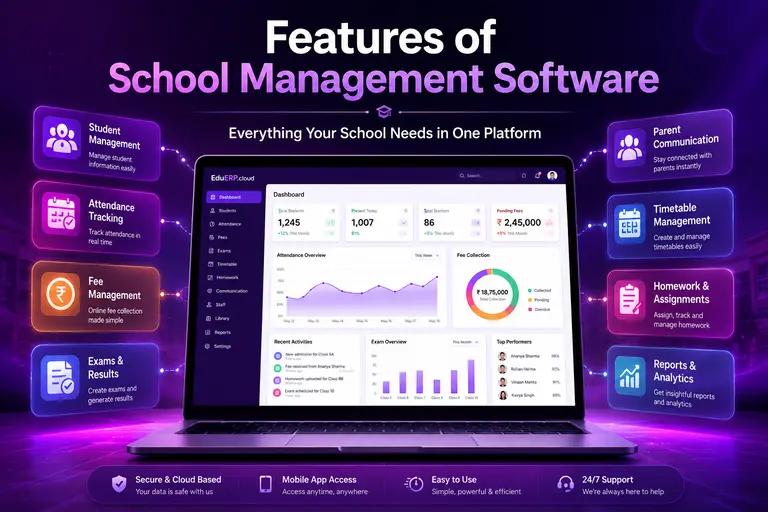
Managing a school involves much more than classrooms and teaching.
Every day, schools handle attendance records, fee collection, exams, communication with parents, staff management, and administrative tasks. As the number of students grows, managing everything manually becomes difficult and time-consuming.
That is why many schools are now moving towards digital systems.
School management software helps schools organize daily operations from one platform. Instead of depending on registers, paperwork, and multiple spreadsheets, schools can manage everything through a centralized system.
But before choosing any software, schools first want to understand one important thing:
What features actually matter in school management software?
In this guide, we will explore the most important features of school management software and how they help schools improve efficiency, save time, and reduce administrative workload.
What is School Management Software?
School management software is a digital platform designed to help schools manage academic and administrative operations.
It allows schools to handle:
- Student records
- Attendance
- Fees
- Exams
- Communication
- Staff management
from one connected system.
Instead of managing separate processes manually, schools can automate daily tasks and improve organization across departments.
The main goal of school management software is simple:
To make school operations faster, smoother, and more efficient.
Why Features Matter Before Choosing Software
Not all school management systems are the same.
Some platforms offer only basic functions, while others provide complete ERP solutions with advanced automation and reporting tools.
Many schools make the mistake of choosing software based only on pricing or advertisements.
But the real value of software depends on its features and usability.
The right features can:
- Save administrative time
- Reduce errors
- Improve communication
- Simplify reporting
- Increase operational efficiency
That is why understanding the core features is extremely important before selecting any school ERP system.
Essential Features of School Management Software
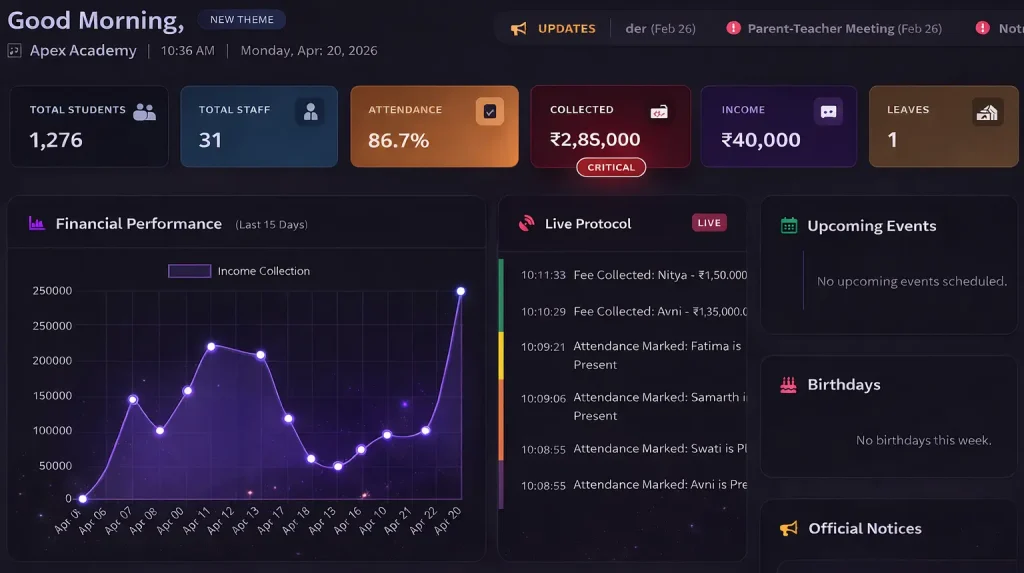
1. Student Information Management
This is one of the most basic and important features.
A school management system should allow schools to store complete student information digitally.
This usually includes:
- Admission details
- Personal records
- Academic history
- Class information
- Contact details
- Documents
Instead of searching through files or registers, schools can access student information instantly from one dashboard.
This improves organization and saves time.
2. Attendance Management System
Manual attendance tracking consumes a lot of time, especially in larger schools.
Digital attendance management allows teachers to mark attendance quickly through the system.
The software can automatically generate:
- Daily reports
- Monthly summaries
- Attendance percentages
- Absent student notifications
Some modern ERP systems also support mobile attendance and biometric integration.
This reduces manual work and improves accuracy.
3. Fee Management and Online Payments
Fee management is often one of the most sensitive parts of school administration.
Manual fee tracking can create confusion, delayed updates, and calculation errors.
A good school management software should include:
- Fee collection tracking
- Online payment integration
- Digital receipts
- Pending fee reports
- Automatic reminders
- Financial summaries
Online payment support has become especially important for schools in India as digital transactions continue to grow rapidly.
4. Exam and Result Management
Preparing exams and report cards manually takes significant time and effort.
School ERP systems simplify this process by automating exam-related tasks.
Schools can:
- Create exam schedules
- Upload marks
- Generate report cards
- Calculate grades automatically
- Prepare performance reports
This improves efficiency and reduces calculation mistakes.
It also helps schools maintain organized academic records.
5. Parent Communication System
Communication between schools and parents has become more important than ever.
Parents expect regular updates about:
- Attendance
- Homework
- Exams
- Notices
- School activities
A strong communication module allows schools to send updates instantly through:
- Mobile apps
- SMS alerts
- Notifications
- Circulars
This improves transparency and strengthens parent trust.
6. Mobile App Access
Modern school management software should not be limited to desktop use.
Mobile accessibility has become a major requirement for schools, teachers, and parents.
A mobile-friendly ERP system allows users to:
- Access attendance
- Check fee status
- Receive notifications
- View exam results
- Manage communication
from anywhere.
This flexibility improves convenience and increases system usage.
7. Staff and Employee Management
Schools also need proper systems for managing teaching and non-teaching staff.
A staff management module helps schools handle:
- Employee records
- Attendance
- Salary information
- Leave management
- Timetables
This reduces administrative complexity and keeps staff information properly organized.
8. Timetable Management
Creating and managing school timetables manually can become complicated.
School management software simplifies timetable creation by organizing:
- Class schedules
- Teacher assignments
- Subject periods
- Room allocation
Changes can also be updated quickly without creating confusion.
This improves coordination across departments.
9. Homework and Assignment Tracking
Many modern school ERP systems now include homework management features.
Teachers can upload assignments digitally, and students or parents can access them through the app.
This feature helps schools maintain better academic communication and reduces dependency on physical homework diaries.
10. Report Generation and Analytics
Reports are extremely important for school administration.
A good ERP system should provide automated reporting tools for:
- Attendance
- Fees
- Exams
- Financial data
- Student performance
Instead of preparing reports manually, administrators can generate them instantly.
Some advanced systems also provide graphical analytics and dashboards for better decision-making.
11. Cloud-Based Access
Cloud-based school management software is becoming increasingly popular.
Unlike traditional offline software, cloud systems allow schools to access data securely from anywhere.
This provides several advantages:
- Remote access
- Automatic backups
- Better security
- Multi-device support
- Easier maintenance
Cloud systems are generally more flexible and scalable for modern schools.
12. Data Security and Backup
Schools manage large amounts of sensitive information.
That is why data security is a critical feature.
A reliable school ERP system should include:
- Secure login systems
- Backup support
- Access control
- Data protection measures
This helps schools protect important records from loss or unauthorized access.
13. Transport Management
Schools with transportation facilities often require transport management modules.
This feature helps manage:
- Bus routes
- Driver information
- Pickup schedules
- Transport fees
Some advanced systems even support GPS tracking for better monitoring.
14. Library Management
Library management features help schools organize book records digitally.
Schools can manage:
- Book inventory
- Issue and return records
- Student borrowing history
- Due date reminders
This reduces manual paperwork inside the library department.
15. Admission Management
Admission periods usually create heavy administrative workload.
Admission management features simplify:
- Student applications
- Registration
- Document uploads
- Inquiry tracking
- Admission reports
This helps schools manage admissions more efficiently and professionally.
Why Schools Need an All-in-One ERP System
Many schools use separate tools for attendance, fees, communication, and academics.
This often creates confusion and data duplication.
An all-in-one ERP system connects every department inside one platform.
This improves:
- Coordination
- Accuracy
- Reporting
- Communication
- Administrative efficiency
Instead of managing multiple systems, schools can operate from one centralized dashboard.
Choosing the Right Features for Your School
Not every school requires the same features.
A small school may only need:
- Attendance
- Fees
- Parent communication
while larger institutions may require complete ERP functionality.
Before selecting software, schools should first identify their operational needs.
The best software is not the one with the most features.
It is the one that solves real problems effectively.
The Future of School Management Software
School management is becoming more digital every year.
Modern ERP systems are now focusing on:
- AI-based analytics
- Mobile-first communication
- Cloud automation
- Real-time reporting
- Smart dashboards
Schools that adopt digital systems early are able to improve efficiency and stay better organized.
This shift towards automation is expected to grow even faster in the coming years.
Simplifying School Operations with the Right Software
Managing a school manually becomes difficult as operations expand.
A good school management software helps schools reduce workload, improve communication, and organize daily tasks more efficiently.
From attendance and fees to exams and parent communication, the right ERP system can simplify every part of school administration.
Platforms like EduERP.cloud are designed to help schools manage operations through one centralized and easy-to-use system built for modern educational institutions.
Ready to Modernize Your School Management?
If your school is planning to move towards a smarter and more organized system, choosing the right software is an important step.
Explore how digital school management can save time, reduce errors, and improve daily operations with a modern ERP platform.